
VIRGINIE MARTIN
:: IMAGINER :: RÉALISER :: EXPÉRIMENTER ::


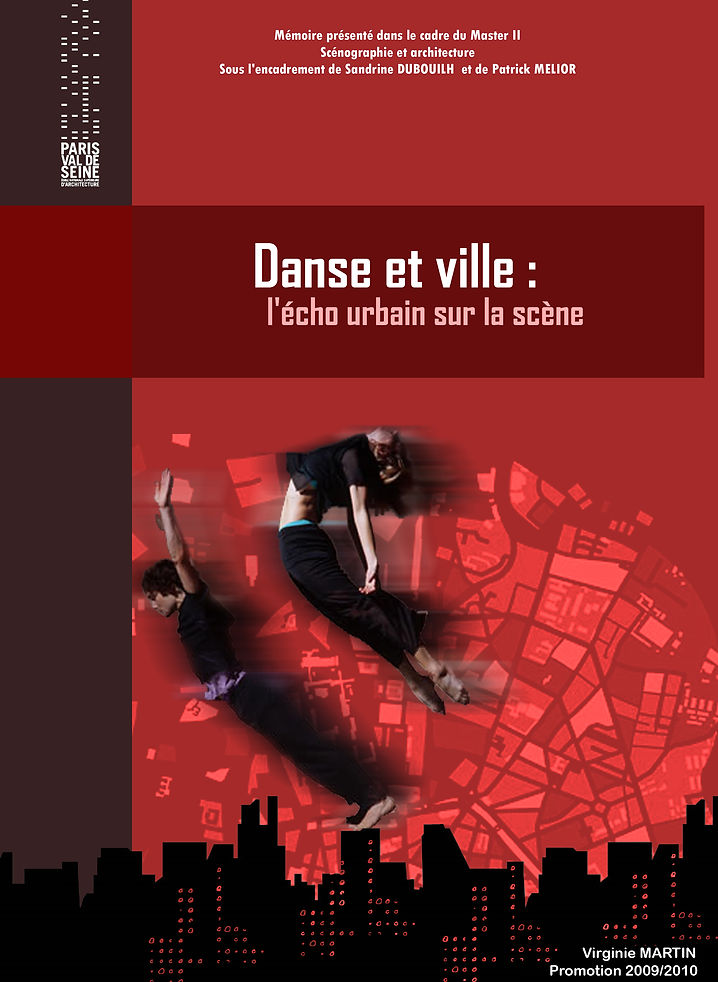
Danse et ville
L'écho urbain sur scène
Dans les années 1970, des chorégraphes indépendants quittent les scènes traditionnelles pour danser dans les rues, les immeubles et les lieux atypiques. En bouleversant les codes de la représentation, ils transforment le spectateur en « spect‑acteur », déplacé, surpris, immergé dans des perspectives nouvelles. Trisha Brown ou Lucinda Childs déplacent ainsi la danse dans l’espace public ou muséal, rompant avec la frontalité théâtrale.
En parallèle, la culture hip‑hop fait émerger le krump, le smurf et le breakdance, dont les gestes s’ancrent dans l’architecture urbaine. Ces pratiques, nées directement dans la rue, inventent une nouvelle relation entre corps et ville, en se servant de mobiliers, du dénivelé du tissu urbain, de l'obstacle pour imaginer et faire exister une nouvelle forme de danse émergeante.
Peu à peu, le théâtre s’intéresse à ces formes hybrides et invite ces danseurs à occuper ses plateaux. Leur arrivée transforme la scène : les chorégraphes déjouent les règles, rendent le cadre poreux, brouillent la frontière entre salle et scène. Trisha Brown grimpe sur le cadre, Childs éclate l’espace chorégraphique, révélant la machinerie et insufflant un souffle urbain dans l’édifice théâtral.
Une nouvelle génération s’empare ensuite de ces héritages. Frédéric Flamand, notamment, collabore avec des architectes comme Jean Nouvel ou Zaha Hadid, intégrant contraintes spatiales et structures imposantes au cœur de la création comme un écho de la ville sur scène. Ces scénographies questionnent le corps dans l’espace non plus vide, mais avec des obstacles scénographiques, ses limites et ses possibles.
Cette complicité entre danse et architecture transforme aussi le public, invité à adopter de nouvelles positions et à devenir partie prenante du spectacle. Certains chorégraphes, comme William Forsythe, déplacent même le public hors du théâtre pour prolonger l’expérience dans la ville.
Ce mémoire montre comment ces mouvements ont transformé à la fois l’espace scénique et ses usages, et ont ouvert un champ infini de possibles pour les corps en danse.
In the 1970s, independent choreographers left traditional stages to dance in streets, buildings and unconventional spaces. By overturning the codes of representation, they transformed the spectator into a “spect‑actor,” displaced, surprised and immersed in new perspectives. Trisha Brown and Lucinda Childs thus brought dance into public and museum spaces, breaking away from theatrical frontality.
At the same time, hip‑hop culture gave rise to krump, smurf and breakdance, whose movements became anchored in urban architecture. Born directly in the street, these practices invented a new relationship between body and city, using street furniture, urban gradients and obstacles to imagine and shape an emerging form of dance.
Gradually, the theatre took interest in these hybrid forms and invited these dancers onto its stages. Their arrival transformed the scenic space: choreographers disrupted established rules, made the frame porous, and blurred the boundary between audience and stage. Trisha Brown climbed onto the proscenium, Childs fractured choreographic space, revealing the machinery and infusing the theatrical building with an urban breath.
A new generation then embraced these legacies. Frédéric Flamand, in particular, collaborated with architects such as Jean Nouvel and Zaha Hadid, integrating spatial constraints and imposing structures at the heart of creation as an echo of the city on stage. These scenographies questioned the body in a space no longer empty but filled with scenic obstacles - its limits and its possibilities.
This dialogue between dance and architecture also transformed the audience, invited to adopt new positions and become an active part of the performance. Some choreographers, like William Forsythe, even moved the audience outside the theatre to extend the experience into the city.
This thesis shows how these movements transformed both the scenic space and its uses, opening an infinite field of possibilities for dancing bodies.
Mémoire dans le cadre du diplôme DEA 2010 ENSAPVS